An Opinion Piece by Joe Laureat, Joshua Justus| UEFA Champions League 2025-26
Let’s be honest.
For years, the Champions League, fondly called “the UCL”, has had a dirty little secret. The big clubs like Real Madrid, FC Bayern Munich, PSG, and Barcelona could sleepwalk through the group stage, drop a few results here and there and still coast into the knockouts without stressing too much. The format was predictable and frankly, it was getting a little boring.
However, the new format that UEFA introduced (a 36-team league phase) has done something remarkable. Results matter every single week, so it has removed the safety net from the giants of European football.
Let’s analyse it together.
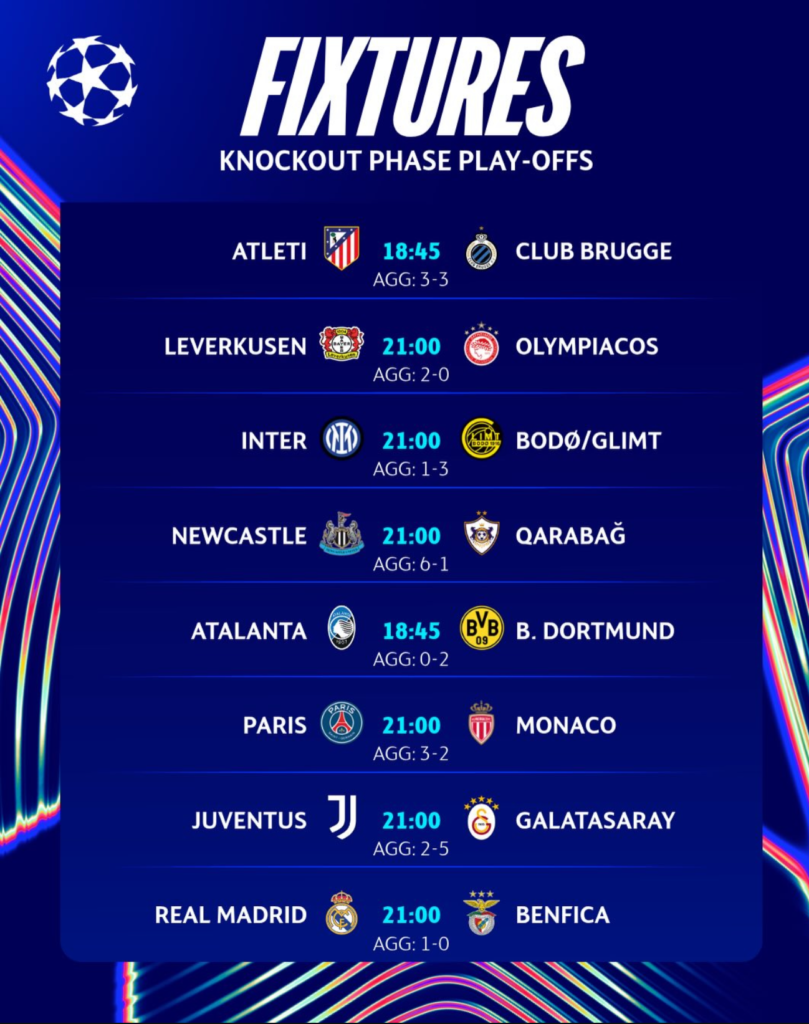
Real Madrid and Paris Saint-Germain are currently fighting for their lives in the knockout playoff round. Not the round of 16 but the playoffs. And these are two of the biggest clubs in the world who would originally scale through.
What should that tell you– they couldn’t even finish in the top 8 of the league phase.
I’ll grab a popcorn at this point.
The Old World vs The New Reality
Under the previous format, a club like Real Madrid could lose one or two games, finish second in their group and qualify for the final as if it was written in the stars. You and I can agree that the road to glory was paved with comfort.
Smaller clubs that pulled off surprising results could celebrate a once-in-a-lifetime win, but ultimately watch the European giants ride on to the round of 16 effortlessly.
But the new format has changed all of that. 36 clubs, 8 matches in the league phase and only the top 8 qualify for the round of 16. How interesting. Participants from 9th to 24th have to survive a two-legged playoff to keep their UCL hopes alive. Meanwhile, teams that finish 25th or below can work harder next time.
Take a look at Real Madrid, who finished 9th in the league phase, while the reigning champions (Paris Saint-Germain), for the second consecutive year, couldn’t finish in the top 8. Nerve-racking.
But what does this prove? The format is ridiculously challenging, but is it due to fatigue or underdog awakening?
The Little Guys Finally Have Something to Play For
Here is where the new format gets exciting. The previous system was great for the so-called “big boys”, and for everyone else, it was a participation trophy. Nonetheless, this format gives smaller clubs meaningful opportunities throughout the league phase.
For example, teams like Bodø/Glimt or Qarabag have managed to rack up results that have kept them alive in the competition. So, smaller clubs can actually accumulate points over 8 games, unlike the previous format, where your faith was sealed in 6 games.
As a result, the margin for error has shrunk for everyone, and even the strongest teams can no longer afford to slip up.
There’s also the question of the playoff round itself. For a club like Monaco to face PSG, or Benfica to face Real Madrid, in a two-legged tie. That is elite-level football for clubs who, under the previous format, might have been relegated to the Europa League at this point in the competition.
What a relief! Their fans get to dream, and more importantly, the players get to test themselves at the highest level. Honestly, money can’t buy this injection of jeopardy.
The Impact on Players
For players, the new format is both thrilling and exhausting. The previous format offered footballers high-profile games with less intense fixtures. Now, every Champions League night carries weight. A run of poor performances in the league phase can genuinely knock your club out of contention before December.
Meanwhile, that pressure cuts both ways. Players like Erling Haaland, Vinicius Júnior or Ousmane Dembélé are expected to perform when it matters, and the format ensures that there are far more occasions that ‘matter’ than there used to be.
But for players at smaller clubs, the new format is a career opportunity. 8 games of intense football, rather than a brief group stage cameo. This means: more exposure, more visibility and a genuine chance to make a name on the biggest stage in club football.
What It Means for Fans
If you’re a supporter of one of the big clubs, the new format can feel brutal. As usual, you expect your team to dominate, but they scramble in February just to reach the last 16. The anxiety levels at the Bernabéu and the Parc des Princes this month have been palpable.
An unforgettable moment was the drama of Trubin’s header against Real Madrid, which was watched by millions, and it became one of the defining moments of European football in 2026. That is the kind of moment this format creates.
It forces the big clubs to perform, and when they don’t, it punishes them in a way that the world can watch in real time.
Has the new format worked?
Unequivocally, yes. The new Champions League format has made the competition better; it has created more drama, more meaningful matches, more opportunities for smaller clubs and far more accountability for the big boys.
The sight of big clubs like Real Madrid and PSG sweating through the playoff round is proof that the format is working exactly as intended. They no longer get to show up, rack up points and carry on to the latter rounds by divine right.
They have to earn it, just like everyone else. And when they don’t? The format is ruthless enough to punish them.
For years, we watched the big teams treat the early rounds as a pre-season game. Now those same teams are the ones who can’t afford to switch off, even for a moment. That’s not a bad thing. That’s football.